Programme Summary — Diploma in Pharmacy
Level: Diploma
Duration: 3 Years (6 Semesters)
Mode of Study: On-Campus
Tuition Fee: USD 200 per semesterLocation: Eden Village, Juba, South Sudan
Overview
The Diploma in Pharmacy is a robust three-year academic and clinical programme designed to train highly competent pharmacy technicians and pharmaceutical healthcare professionals tailored to the specific health infrastructure and needs of South Sudan. As South Sudan continues to strengthen its national health facilities and supply chain management systems, the demand for qualified pharmaceutical personnel in hospitals, community pharmacies, humanitarian supply hubs, and regulatory bodies has grown exponentially.
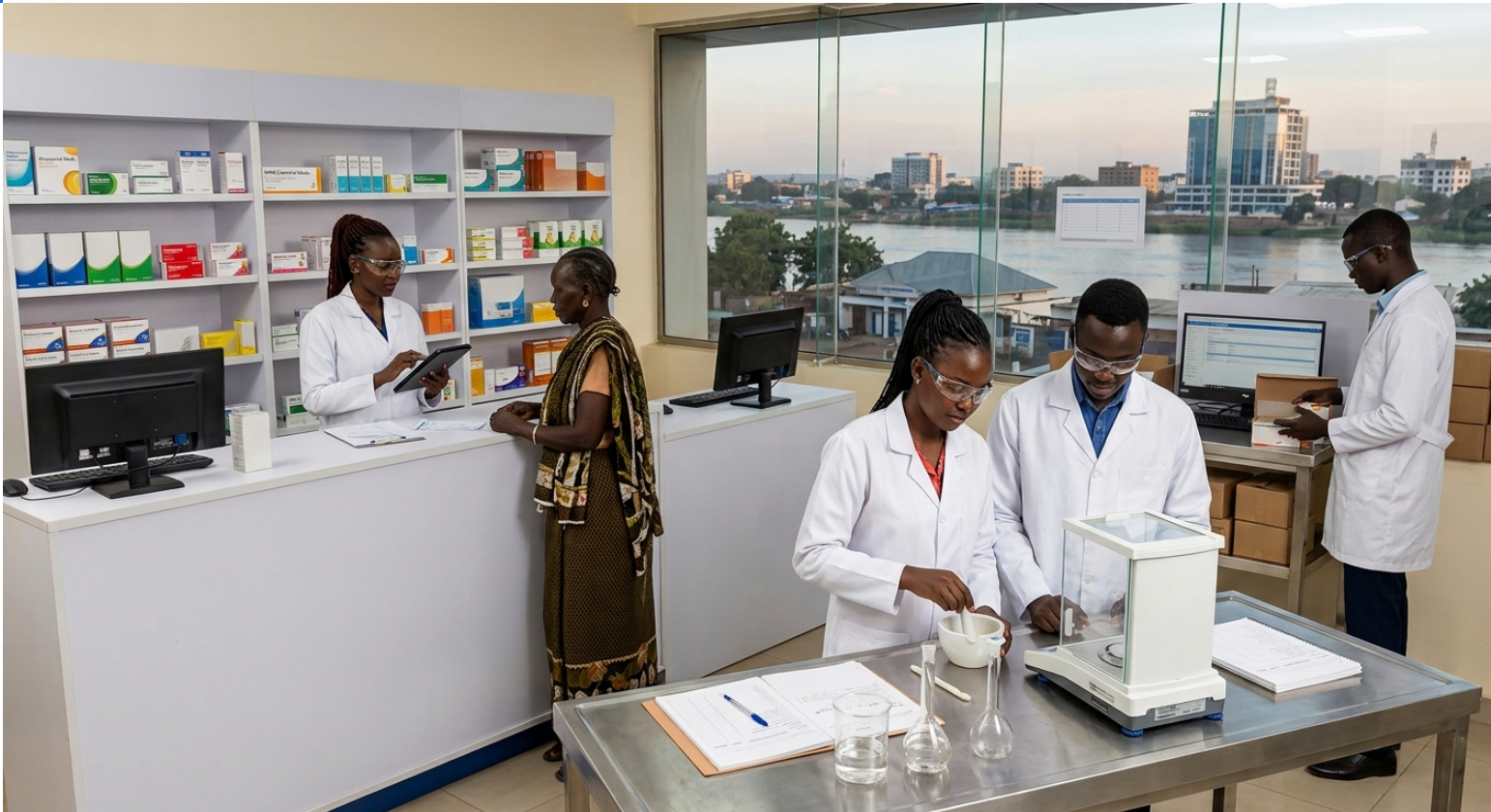
The programme combines rigorous classroom instruction in basic medical sciences and pharmacology with practical laboratory compounding, pharmaceutical calculations, drug inventory management, and supervised clinical/dispensary placements in healthcare facilities across Juba and surrounding areas.
Programme Objectives
The programme prepares students to:
- Dispense medications safely and accurately in accordance with legal and ethical standards in South Sudan.
- Provide essential patient counseling on prescription usage, drug dosage, contraindications, and potential side effects.
- Manage pharmaceutical supply chains, including procurement, proper cold-chain storage, inventory control, and distribution in clinical and humanitarian settings.
- Perform extemporaneous pharmaceutical compounding and dosage form preparations in standard pharmacy laboratory settings.
- Promote rational drug use and combat antimicrobial resistance (AMR), a key public health priority in East Africa.
- Collaborate effectively with multidisciplinary medical teams (doctors, nurses, and clinical officers) to optimize patient therapy outcomes.
- Understand and apply national drug regulations established by the South Sudan Drug and Food Control Authority (DFCA) and Ministry of Health.
Programme Structure & Areas of Learning
The curriculum spans six academic semesters over three years, integrating foundational sciences, specialized pharmaceutical disciplines, and hands-on clinical attachments.
Key Areas of Study Include:
- Human Anatomy & Physiology: Structural and functional framework of the human body.
- Pharmaceutical Chemistry & Organic Chemistry: Chemical structure, stability, and reactivity of medicinal compounds.
- Pharmaceutics & Compounding: Formulation, manufacturing principles, and extemporaneous preparation of dosage forms.
- Pharmacology & Therapeutics: Mechanisms of drug action, pharmacokinetics, adverse effects, and therapeutic applications.
- Pharmacognosy & Natural Products: Study of medicinal plants and natural products relevant to traditional and modern therapy in South Sudan.
- Microbiology & Parasitology: Pathogenic microorganisms, sterilization techniques, and infectious disease management.
- Pharmacy Practice & Ethics: Prescription handling, ethical standards, communication, and patient counseling.
- Essential Medicines & Supply Chain Management: Quantification, procurement, storage, and logistics of medical supplies in humanitarian and public health sectors.
- Pharmaceutical Regulations & Laws: Legal frameworks governing drug importation, distribution, and control in South Sudan.
Clinical & Practical Training
Practical training is integrated into the programme through state-of-the-art laboratory practicals and compulsory hospital and community pharmacy attachments. Students complete supervised clinical rotations in major public and private health facilities in Juba, including teaching hospitals, humanitarian medical stores, and retail pharmacies. These attachments enable students to experience real-world prescription processing, stock management, patient counseling, and clinical collaboration.
How to Apply:
- Obtain and complete the MIHS Application Form online via the official portal or in person at the Eden Village Campus in Juba.
- Attach certified academic certificates and required identity documentation.
- Submit the completed application for review by the Admissions Office and complete registration upon receipt of the admission letter.
Eligibility
Completion of the South Sudan Secondary School Certificate (SSSCE) or its recognized international equivalent with credit passes in English, Mathematics, Chemistry, Biology, and Physics.
Submission of official academic transcripts, certificate copies, national identification/passport, and passport-sized photographs.
Meeting the general admission criteria set by the MIHS Academic Board and relevant health regulatory bodies.
Career Paths
- Hospital Pharmacy Technicians in public and private hospitals.
- Community Pharmacists / Dispensers in retail and wholesale pharmaceutical outlets.
- Medical Logistics and Supply Chain Officers for International NGOs, WHO, UNICEF, and humanitarian organizations.
- Quality Control and Inspection Assistants with the Drug and Food Control Authority (DFCA).
- Pharmaceutical Sales Representatives and Product Specialists for medical distribution agencies.
- Research and Laboratory Assistants in academic and industrial health facilities.
Curriculum
Semester 1:
- Human Anatomy & Physiology
- Pharmaceutical Chemistry & Organic Chemistry I
- Microbiology & Parasitology
- Pharmacy Practice & Ethics I (Introduction to healthcare ethics, communication, and medical terminology)
Semester 2:
- Pharmaceutics & Compounding I (Formulation fundamentals and dosage forms)
- Pharmaceutical Chemistry & Organic Chemistry II
- Pharmacognosy & Natural Products
- Basic Practical Laboratory Rotations
Semester 3:
- Pharmacology & Therapeutics I
- Pharmaceutics & Compounding II (Extemporaneous preparation and manufacturing principles)
- Pharmaceutical Regulations & Laws
- Essential Medicines & Supply Chain Management I (Quantification, storage, and procurement)
Semester 4:
- Pharmacology & Therapeutics II
- Essential Medicines & Supply Chain Management II (Logistics in public health and humanitarian sectors)
- Pharmacy Practice & Ethics II (Prescription processing and patient counseling)
- Intermediate Hospital & Community Pharmacy Laboratory
Semester 5:
- Advanced Clinical Therapeutics & Patient Counseling
- Public Health Pharmacy & Infectious Disease Management
- Supervised Clinical Attachment I (Community & Retail Pharmacy Attachment)
Semester 6:
- Supervised Clinical Attachment II (Teaching Hospital Pharmacy & Humanitarian Medical Store Rotations)
- Practical Board Examinations & Licensing Preparation
Fees
Tuition Fee: USD 200 per semester The tuition fee covers core academic instruction, practical laboratory session access, and library resources. Additional examination, registration, and clinical attachment fees will be detailed upon application.