Programme: Diploma in Public and Environmental Health
Level: Diploma
Course Code: DPEH
Duration: 3 Years (6 Semesters)
Mode of Study: 100% Online (e-Learning)
Tuition Fee: USD 300 per semester
Delivery Department: Open, Distance, and e-Learning (ODeL) Department, MIHS
Overview
The Diploma in Public and Environmental Health (DPEH) is a specialized three-year diploma programme delivered exclusively online through the Meridian Institute of Health Sciences ODeL department. Strictly focused on preventive health, environmental safety, sanitation, and disease control (excluding clinical medicine practice), this curriculum aligns directly with the national health policy framework established by the Ministry of Health, Republic of South Sudan.
Environmental sanitation, clean water access, vector control, and epidemic outbreak response represent primary public health challenges across South Sudan’s ten states and administrative areas. This online diploma equips students with essential preventive medicine competencies to protect communities from environmental hazards and waterborne communicable diseases.
Programme Objectives
The programme aims to:
- Plan, implement, and monitor Water, Sanitation, and Hygiene (WASH) interventions in urban, rural, and displacement/refugee settings.
- Conduct environmental health impact assessments, safety inspections, and pollution monitoring.
- Implement disease surveillance systems and execute outbreak control measures for communicable diseases (e.g., cholera, malaria, hepatitis).
- Educate and mobilize communities on environmental hygiene, waste management, and disease prevention strategies.
- Apply biostatistics and epidemiological tools to assess public health trends and evaluate intervention efficacy.
- Enforce health and safety regulations, food hygiene standards, and municipal environmental health policies.
Programme Structure & Areas of Learning
The programme spans six online semesters. It strictly emphasizes population health, epidemiology, and environmental management.
Key Areas of Study Include:
- Epidemiology & Communicable Disease Control: Study of disease patterns, outbreak investigation, and preventive interventions.
- Water, Sanitation & Hygiene (WASH): Water quality testing, treatment technologies, latrine design, and hygiene promotion.
- Environmental Health & Toxicology: Waste management (solid, hazardous, medical), air/water pollution, and chemical safety.
- Vector Control & Parasitology: Management of disease vectors (mosquitoes, flies, rodents) and environmental modification.
- Food Safety & Hygiene Inspection: Inspection of food establishments, slaughterhouses, and food handling practices.
- Occupational Health & Safety (OHS): Workplace hazard prevention, safety compliance, and ergonomics.
- Biostatistics & Health Research: Data collection, public health reporting, and community-based research methods.
- Health Promotion & Community Mobilization: Behavior change communication (BCC) and public health advocacy.
Online Learning & Community Projects
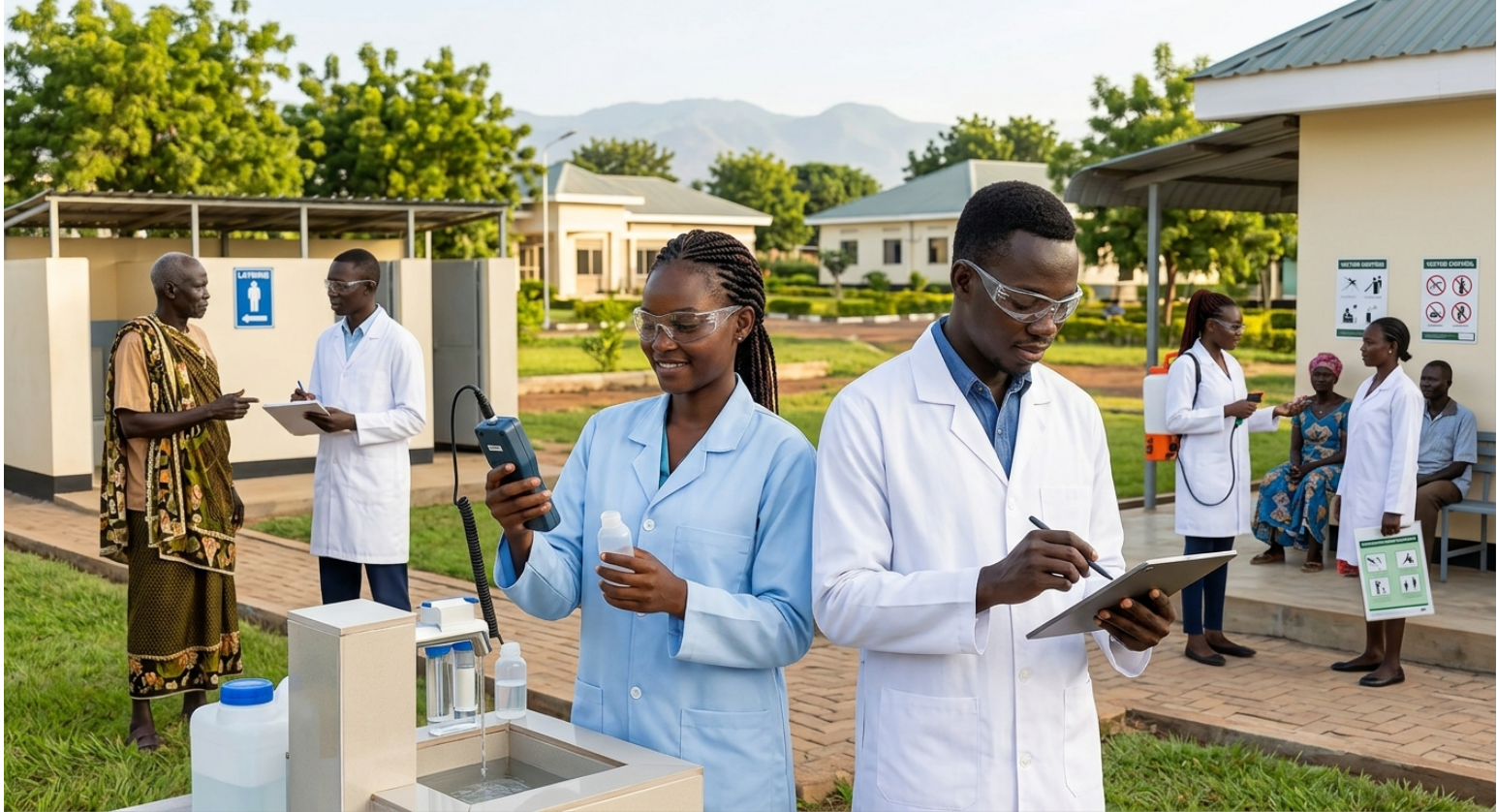
Delivered 100% online, students utilize virtual modules, case study analysis, and asynchronous discussion forums. To complement academic learning, students complete practical field-based community health projects and WASH assessments in their local counties, submitting structured field reports to their online mentors.
Eligibility
Entry Requirements & Tuition
Admission requires a South Sudan Secondary School Certificate (SSSCE) or recognized equivalent.
Career Paths
- Public Health Officers / Environmental Health Officers in county health departments and municipalities.
- WASH Specialists and Project Officers with international NGOs and humanitarian agencies.
- Disease Surveillance Officers in public health institutions.
- Occupational Health and Safety Inspectors in industrial and commercial sectors.
- Health Education and Promotion Coordinators.
Curriculum
Semester 1:
- Fundamentals of Public & Environmental Health
- Anatomy, Physiology & Human Biology
- Biostatistics & Health Research I (Basic data collection and public health reporting)
- Health Promotion & Community Mobilization (Behavior Change Communication [BCC] and advocacy)
Semester 2:
- Epidemiology & Communicable Disease Control I (Disease patterns, surveillance, and basic prevention)
- Biostatistics & Health Research II (Community-based research methods and data presentation)
- Principles of Environmental Health Science
- Introduction to Public Health Laws & Ethics
Semester 3:
- Water, Sanitation & Hygiene (WASH) (Water quality testing, treatment technologies, latrine design, and hygiene promotion)
- Vector Control & Parasitology (Management of mosquitoes, flies, rodents, and environmental modification)
- Epidemiology & Communicable Disease Control II (Outbreak investigation and emergency response)
Semester 4:
- Environmental Health & Toxicology (Solid, hazardous, and medical waste management; air/water pollution; chemical safety)
- Occupational Health & Safety (OHS) (Workplace hazard prevention, safety compliance, and ergonomics)
- Community Water Quality & Sanitation Practical Rotations
Semester 5:
- Food Safety & Hygiene Inspection (Inspection of food establishments, slaughterhouses, and food handling practices)
- Disaster Risk Reduction & Emergency Public Health Management
- Supervised Field Attachment I (Municipal & Community Public Health Rotations)
Semester 6:
- Supervised Field Attachment II (Food Safety Inspection, WASH Field Projects & Industrial OHS Audits)
- Public Health Project / Field Research Report
- Comprehensive Practical Board Examinations & Licensing Prep
Fees
Tuition Fee: USD 300 per semester